
For over fifty years, members of the Garden Club of Montclair have gathered to decorate the Crane House and Historic YWCA in holiday splendor. This year, the almost 100-year-old club committed to making all their decorations as historically accurate as possible. Over this past summer, they began researching the history of how Americans celebrated Christmas through the years, seeking to create a magical experience that draws and delights visitors during these next few weeks, while staying true to the time periods represented in each of the rooms.
Built in 1796 by Israel Crane, a wealthy local merchant, the house was home to the Crane family for over 100 years including enslaved people and servants. In the 1920s, African American women in the community purchased the property to serve as the headquarters for a segregated YWCA. The space housed offices, dormitories, and classrooms, and served as a social and civic center for African American women until 1965.
The Montclair History Center has endeavored to honor all of the time periods and functions of the house, furnishing each room or area in a manner that demonstrates how the room was used during a specific span of time over 200 years. This year, the Garden Club of Montclair has tried to stay true to that goal, by decorating each room with holiday decorations that would have been used during the time period of the room.
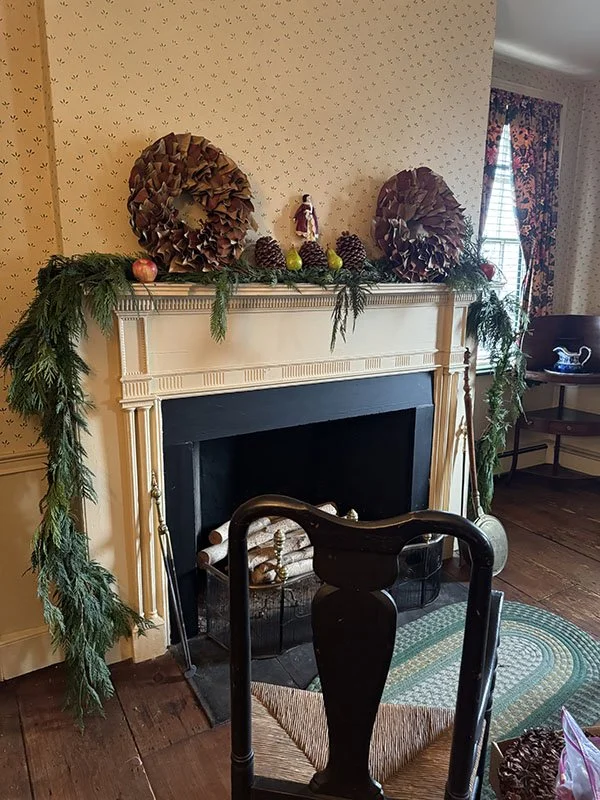
You’ll notice, for example, that the Crane Family Parlor, Entry Hall, and Upstairs Bedrooms, which are furnished to demonstrate their use from 1796 to 1840, are free from certain things normally associated with Christmas. You’ll find no Christmas trees, stockings, lavish gifts, or ribbons. In fact, decorating during this time period would have been spare, with only fruits, nuts, greens, pinecones, dried flowers, and seed pods to indicate that it was anything but a normal day. In fact, the Puritan practice in the 1600s of punishing anyone found to be “celebrating” Christmas, had the long-lasting effect of keeping celebrations intimate and family-focused.
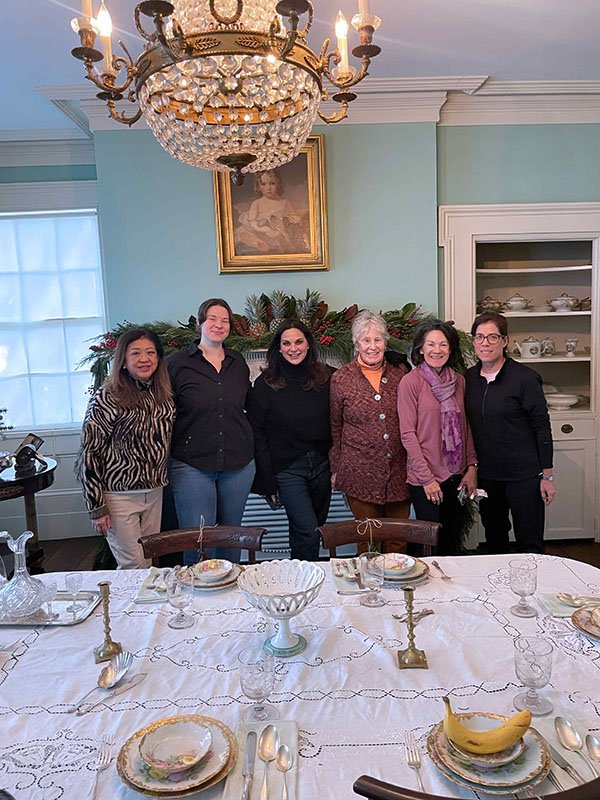
These restrictions were gradually lifted during the time period of the Crane Family Dining Room and the exterior Hearth Kitchen, 1840 to 1900. Christmas trees, first brought to America by German immigrants, caught on in popularity due to Queen Victoria, who, having married Prince Albert of Germany, adopted this tradition and added her own elaborate adornments. The Cranes might have had a tabletop tree during the early period, or perhaps a full-sized tree by the end of the period. They also might have used the first “artificial” tree, made from dyed goose feathers and dowels. The one on display in the Crane Family Dining Room is a replica, made by members of the Garden Club, with actual goose feathers, meticulously wrapped and glued around each branch to resemble the needles of a pine. The tree is decorated with hand-made ornaments, as well as a few purchased glass ornaments, that are true to the time period: paper cones of sweets and nuts, reproduction fabric wrapped into small balls, shapes made from flour and water, ribbon and peppermint candies, chains made from newspaper, and natural seed pods and cones.
The Hearth Kitchen, although representing the same time period as the Crane Family Dining Room, is decorated in a much more rustic manner, as this working space would have probably been overlooked, except by those domestic servants and enslaved workers who occupied it.
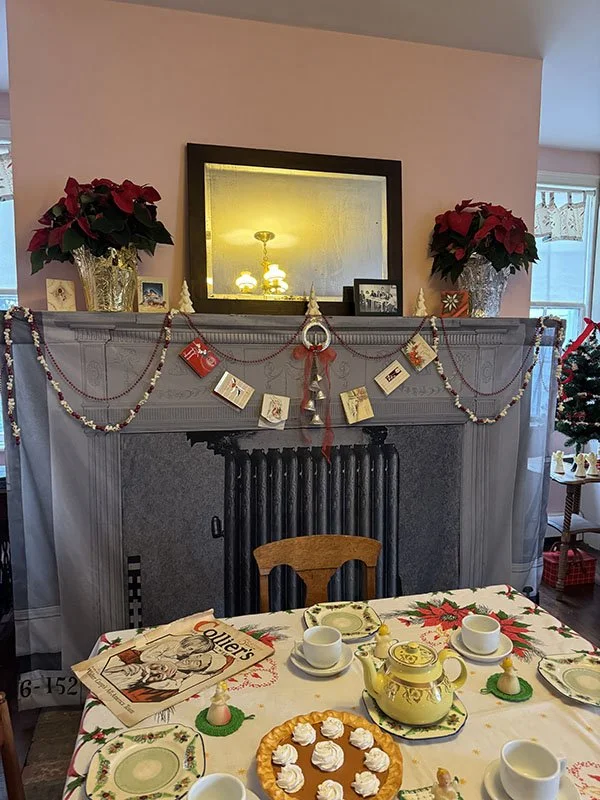
The Boarder’s Dining Room, furnished to represent its use by the African American YWCA from 1920 through 1940, encompassed the Roaring Twenties through the Great Depression. Christmas trees were common, decorated with imported glass spheres and figurative ornaments, strings of beads, as well as electric lights made in Japan. Strings of popcorn adorned the trees, and cardboard stars, bells, and wreaths were covered in tin foil. Holiday cards were routinely sent to family and friends. Garden Club members searched their storage and online sources for period holiday items. A delightful collection of wax figures and candles was donated by a board member of the History Center.
The period between WWII through post-war prosperity is represented in the furnishings of The Club Room, 1940 through 1965. During the early part of this period, war shortages inspired creativity. The “Putz” scene, (pronounced “puts,” the word is derived from a German word meaning to polish, clean, or decorate) a common addition under the tree or on a sideboard, represented the nativity or an idealized village, and was frequently home-made from leftover cardboard scraps, children’s toys, and evergreen cuttings. The post war boom years transformed Americans thoughts about house and home, and Christmas developed a decidedly modern feel.
The Montclair History Center acquired an authentic aluminum tree with a rotating light, to showcase this iconic period. The Garden Club took inspiration from this and found vintage wrapping paper on ebay to adorn the gifts under the tree. Shiny Brite glass ornaments were hung on most trees during this time period, and the Club collected vintage sets from members’ attics, as well as bubble lights, ceramic trees, bric-a-brac, and vintage greeting cards.
The Garden Club of Montclair is delighted to continue their tradition of decorating the Crane House and Historic YWCA for the holidays, and committed to honoring the history of the Crane House by conforming, as much as possible, to historically accurate adornments.
Visit the Crane House and Historic YWCA Museum to see the holiday decorations on Saturdays December 13th and 20th from 12 to 3 pm at 110 Orange Road, Montclair. $5 per person, children under 12 free. Details on holiday tours online here: www.montclairhistory.org/all-events.
Written by Karen Fricke, Garden Club of Montclair.
About the Garden Club of Montclair: The Garden Club of Montclair educates Members and the public in their knowledge and practice of conservation, horticulture, and the artistic use of plant material. We work to beautify the Township of Montclair and the State of New Jersey. The Club sponsors and supports projects of an educational character, specifically allied to these purposes, and fosters fellowship through its work and its social activities. For additional information, please visit the website www.gardenclubofmontclair.org.