
Prairie Cross the Jersey
The Gaslamp, Glen Ridge Historical Society, written by Karin Robinson.
This column will be a little different. I want to connect the distinctive design qualities of three houses: one in suburban Chicago, one in Montclair, and one in Glen Ridge.
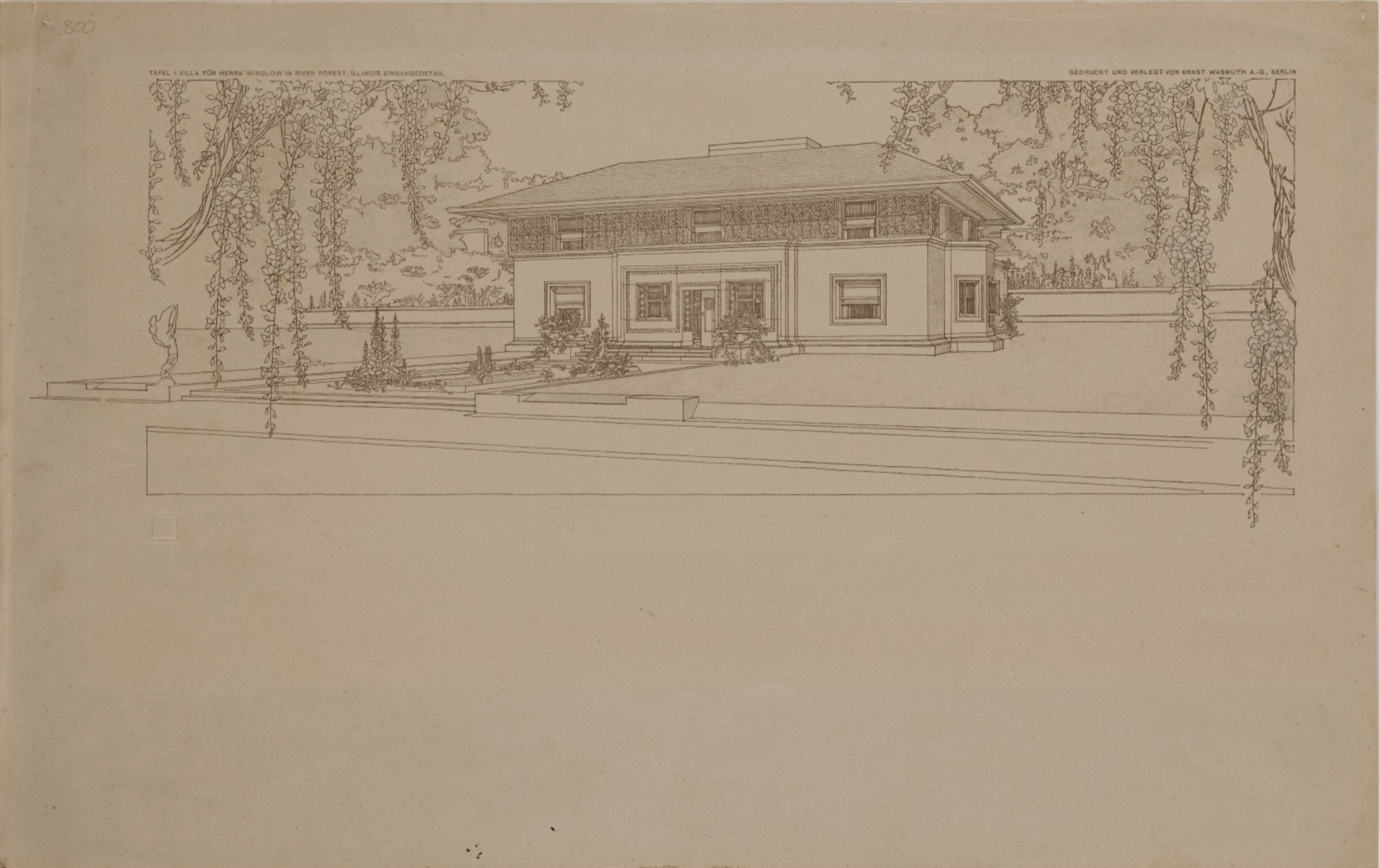
5115 Auvergne Place, River Forest, III.
First is the Winslow House in River Forest, Ill. Designed in 1893 by Frank Lloyd Wright, it was his first major commission. It doesn’t look much like a Frank Lloyd Wright house, but he was just starting out. On the image at right, taken from the Wasmuth Portfolio published in 1910, you can discern the early forms of the Prairie Style houses that made him world-famous. The house is long and low. The shallow hipped roof has broad cantilevered eaves. The second floor appears to be compressed between the eaves resting on wide double-hung windows and the high string course running under the windowsills. The second floor is clad in dark brown terracotta panels, emphasizing the shadow cast by the outstretched eaves. The substantial first floor is built of Roman brick, which is longer and flatter than standard brick, again reinforcing the horizontal impression of the house. The doors and windows are framed in limestone.
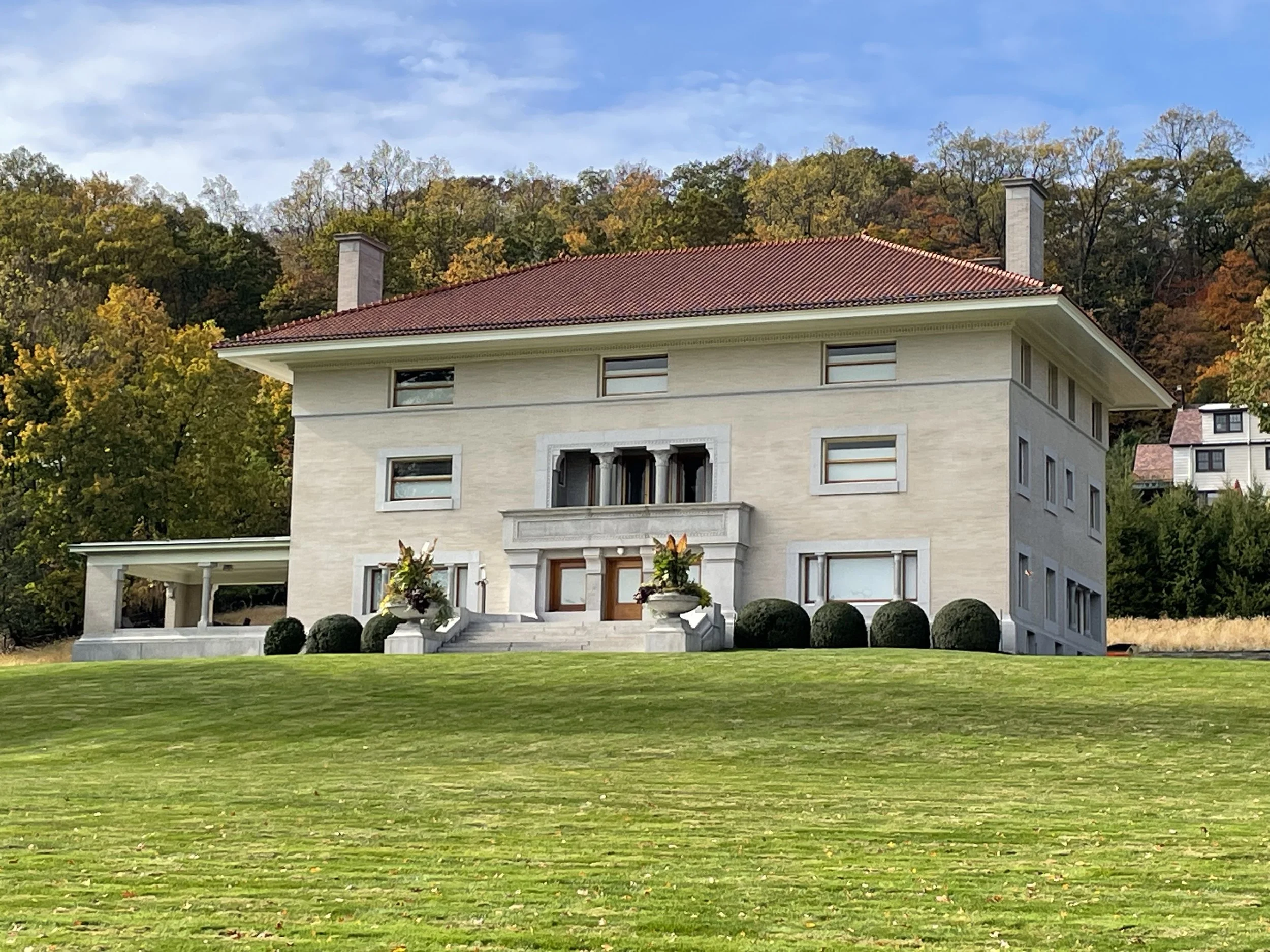
66 South Mountain Ave.
Next is 66 South Mountain Ave. in Montclair. It was designed by George Maher in 1902. Maher knew Wright when they worked together as fledgling architects for the architect Joseph Silsbee in Chicago. Maher and Wright, along with others from Silsbee’s office, became known as the Prairie School because of their shared interest in developing an American style of architecture that fit into the American landscape. The Prairie Style was derived from traditional domestic architecture and the Arts and Crafts movement.
The house was commissioned by Frederick Gates, who had been a Baptist minister but was hired by John Rockefeller Sr. to distribute his enormous wealth toward philanthropic causes. Together they created the Rockefeller Foundation in 1913. Gates traveled frequently across the Midwest and was familiar with Maher’s work, which at the time was as esteemed and popular as Wright’s. At 66 South Mountain Ave. he brought the principles of the Prairie School to a hillside in New Jersey.
At 14,000 square feet it has a massive presence. Like the Winslow House, it is a monolithic block with a broad hipped roof. The top floor is compressed between the broad eaves and a string course under the windows. The widened double hung windows are taken to an impressive extreme.
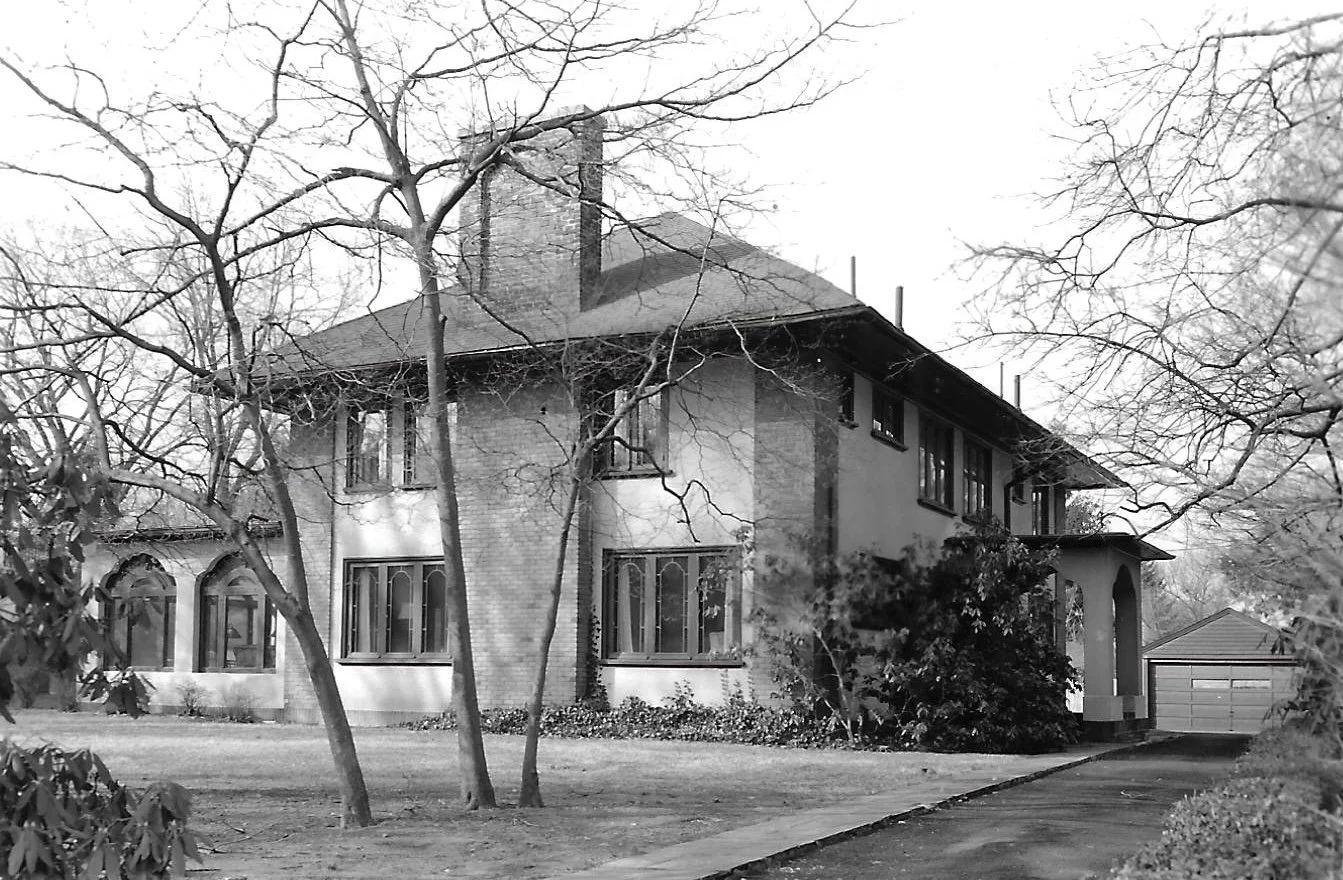
90 Douglas Rd. in 1976
Finally there is 90 Douglas Rd. in Glen Ridge, also designed by Maher and built in 1904. Its structure is hard to see today because of foliage, so I pulled the image at left from the Historical Society archives. It has many of the same characteristics as 66 South Mountain Ave.: a broad, low hipped roof with extended eaves over a blocky volume of similar proportions. It has massive chimneys on each end and a single-story extension on the south side. The flanged segmental arch, consisting of a shallow arch with short horizontal flanges on either side, is Maher’s personal design motif. It’s visible in the windows of the sunroom, the brick recess on the chimney, and the mullion pattern of the windows. Both 90 Douglas and 66 South Mountain are an important part of Maher’s body of work, among the few outside the Midwest.